Oregon House Hacking 2026: Live in One Unit, Rent the Rest

Updated: Oct 6

I do not love the phrase “house hacking.” It sounds like an influencer invented a cheat code last Tuesday.
What people are searching for under Oregon house hacking 2026 is older than any thumbnail. It is the oldest cheap door into 1–4 ownership in this town: you live in one unit and rent the rest. A duplex on a corner lot. A house with a basement apartment. A small fourplex where your bedroom is over the front door and three other doors help pay the note. Portland families have done that for decades. The label is new. The building is not.
This is the long version. How the loan actually qualifies you. Which building keeps which Oregon break. What Portland makes you file before the other door is a cheap win. How to live next to your own tenant without turning the porch into small claims. It is written for the first-time buyer and for the owner who already sleeps on one side and has been treating the other side like a favor.
It is not a class on how to list an occupied 1–4. It is not a free substitute for that class. If you are trying to sell a building with people in it, that is a different job with different notices. Stay here if you plan to move in and operate.
Understanding Oregon House Hacking 2026

Strip the branding and you have a simple plan.
You buy a residential building with two, three, or four dwelling units. You move into one unit as your real home — not a mailing address, not a weekend bag. You rent the other units under Oregon landlord-tenant law. Their rent is supposed to take a bite out of the payment, the tax bill, and the insurance. You learn the business on a building you can walk to in your slippers.
That plan is not the same as:
Renting a spare bedroom down the hall with a shared kitchen. That is a roomer/roommate setup. We already walked those exemptions in February: Oregon Owner-Occupied Rental Exemptions.
Listing your house on a short-term platform. Portland’s accessory short-term rental rules are a different permit, a different tax, and a different occupancy clock. Do not mix that product into this one.
Buying a five-unit or a garden apartment and calling it your “first hack.” At five units, you have left the 1–4 loan world and most of the owner-occupied breaks in Chapter 90.
The three buildings that actually fit this article:
A True Duplex
A true duplex. Two dwelling units, side by side or stacked, usually on one tax lot. This is the cleanest first door. FHA treats it more gently than a three- or four-unit. Oregon’s two-unit owner-occupied termination rule in ORS 90.427(8) is written for this shape. Portland’s duplex relocation exemption is written for this shape.
House Plus an Accessory Dwelling Unit
A house plus an accessory dwelling unit on the same site. Basement apartment, backyard cottage, converted garage with its own kitchen and bath. Legally you may still be in the two-dwelling-unit world if that is all that is on the property. Portland’s ADU relocation path is its own exemption (Exemption 4), not the duplex box. Zoning and whether the unit is a legal ADU matter as much as the rent.
Triplex or Fourplex
A triplex or fourplex where you occupy one unit. The loan can still work. The landlord rules get heavier. Oregon’s two-unit owner-occupied no-cause rule does not follow you to a third door. Portland’s duplex relocation exemption does not follow you to a fourplex. FHA adds a self-sufficiency test and extra cash reserves. Fine building. Different plan.
If you are watching the REACH/Rose City Fund homes from Portland Scattered-Site Sale 2026, some of those 66 are exactly this product: a house or duplex a first-time buyer could live in. That article is the line to stand in for those addresses. This one is how the building behaves after you get the keys.
Why This is the Cheap Door
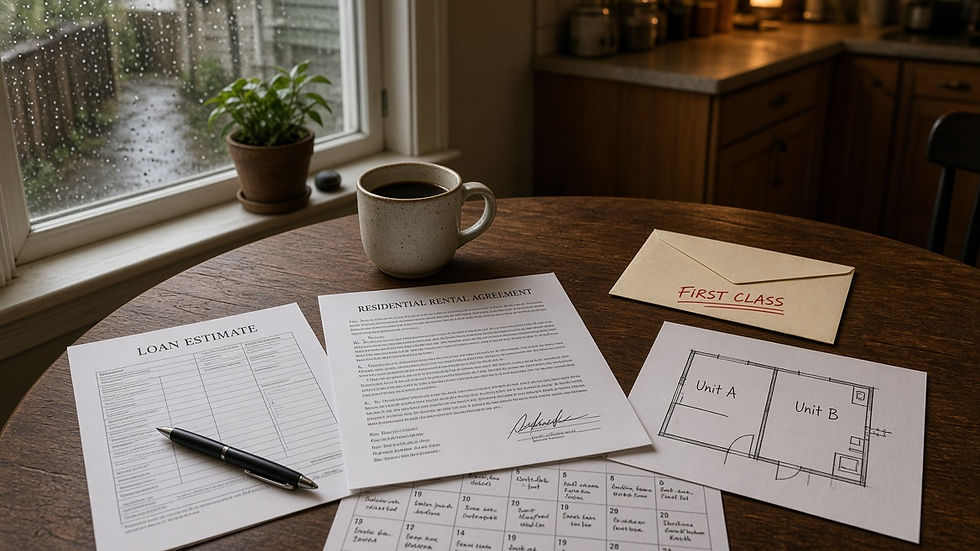
People chase the label because the alternative is a single-family house with a 20 percent investor down payment and a rate that assumes you do not live there.
Owner-occupied 1–4 financing is built for a primary residence that happens to have other doors. FHA is the program most first-time buyers hear first. HUD Handbook 4000.1 lets you finance one to four units if you occupy one of them. Typical picture:
About 3.5 percent down if credit and the rest of the file support it (lower scores can mean more down).
Move in within 60 days of closing.
Intend to live there at least a year.
You may rent the other units from day one.
Lenders can usually count 75 percent of the projected rent on the units you will not occupy toward qualifying income. The other 25 percent is a vacancy-and-upkeep haircut. You still collect 100 percent of the rent when the unit is full.
A duplex does not have to pass FHA’s self-sufficiency test.
A triplex or fourplex does: net rental income, using the handbook’s formula, has to cover the proposed payment. Those purchases also need cash reserves equal to three months of payments after closing.
Conventional owner-occupied 2–4 loans and VA loans have their own occupancy rules, down-payment menus, and ways of counting rent. Some buyers are better on conventional. Some are better on FHA. Talk to a lender who actually closes 2–4 unit notes in the Portland Metro. Do not take the YouTube version of the overlay, and do not use last year’s loan-limit rumor. FHA limits are county-specific and change. Look up the current 2-, 3-, and 4-unit limit for the county where the building sits before you write an offer.

Here is a worked example so the math is not a slogan. These are illustrative numbers, not a 2026 rent survey and not a promise about your street.
Say you buy a Portland duplex for $550,000. You put 3.5 percent down. After principal, interest, taxes, insurance, and FHA mortgage insurance, the payment is $3,600 a month. The other unit can honestly rent for $1,800. For qualifying, the lender may count $1,350 (75 percent of $1,800). In real life, when that unit is occupied, $1,800 hits your account and your out-of-pocket housing cost on the building is about $1,800 — plus vacancy, repairs, and the fact that you still have to keep both units habitable.
Flip the comparison. The same buyer on a $550,000 single-family house with no other door has the whole $3,600 and no rent coming in. That is the entire trick. It is not free housing. It is a second door that is supposed to work.
Now run the ugly version of the same example, because that is the one that shows up in January. The other unit sits vacant for six weeks. A water heater dies. Insurance moved again. You still owe $3,600. Oregon’s rent cap still limits what you can do on the occupied side next year if the building is fifteen years or older. The “hack” does not print a reserve account for you. You have to keep one.

New self-guided course — Oregon House Hacking: Buy a 2–4 Unit and Live in One. Browse courses →
The Loan Will Let You In. It Will Not Run the Rental.
You generally may not buy a fourplex on an FHA note, never move in, and treat every door as an investment. That is occupancy fraud, not a strategy. The occupancy box on the loan application is a promise to the lender and to HUD. It is not an exemption from ORS Chapter 90.
Title matters more than people think. Most owner-occupied FHA files want the occupying borrower on title as a human being. If your plan is “close in the LLC so it looks professional,” stop and ask the lender before you make an offer. An entity that cannot occupy a primary residence is a common way to kill the cheap loan. You can revisit entity structure later with a CPA and an attorney. Do not let a Reddit org chart choose your first note.
After you have honestly lived there for a year, you can generally move out and keep the FHA loan in place. The building can become a fully rented 1–4. Two things fall off when you leave:
Oregon’s two-unit owner-occupied termination break in ORS 90.427(8). That rule requires the building or property to contain not more than two dwelling units and that the rented unit sit in the same building or on the same property as your primary residence. Move out and you are an ordinary landlord on that statute.
Portland’s duplex and on-site ADU relocation exemptions. Those are principal-residence tests, including a six-month lookback before a triggering event on the duplex path. Sleeping in Sellwood while the duplex is in Lents is not “on site.”
Circumstances change. A job in Bend, a kid, a divorce. Honest changes after a real occupancy period are different from never intending to move in. Do not build a twelve-month Airbnb calendar on an FHA occupancy certification.
Common Mistakes to Avoid
You never really move in. A storage unit and a friend’s couch is not occupancy.
You close in an entity the loan cannot live in. Ask before the offer.
You skip the PHB letter and assume Portland will notice you live there. They will notice when someone asks for relocation money.
You use a handshake lease. Judges read paper.
You raise rent like the building is brand new. Check the certificate of occupancy year and ORS 90.323 before you pick a number. Check Portland associated housing costs before you add parking or a “utility admin” line.
You treat a voucher household as a different class of tenant. Source of income is not a free decline.
You buy occupied and assume recording equals vacant. It does not.
You keep a homeowner policy silent about the rented unit. The claim is when you find out.
You spend the other unit’s rent as if vacancy were illegal. It is not.
10. You add a third door — a backyard cottage on a duplex lot — and think every exemption came with you. Count the dwelling units again.
New self-guided course — Oregon House Hacking: Buy a 2–4 Unit and Live in One. Browse courses →
What This Is Not
This is not a listing class.
This is not a notice class for a seller who wants an owner-occupant buyer.
This is not permission to skip habitability because “they knew the furnace was old when they moved in.”
This is not a promise that the other door will cover the whole payment on every Portland street in 2026. Insurance, taxes, and a 9.5 percent cap on older units are why some of those spreadsheets lie.
Oregon house hacking 2026, in ordinary words, is this: buy a small building, live in one unit, rent the others, keep the loan honest, file the Portland paperwork if you are in the city, and treat the other door like a rental from the first application. Do that and you have the same first property a lot of us started on. Dress it up as a hack if you want. Just do not believe the hack removes the statute.
New self-guided course — Oregon House Hacking: Buy a 2–4 Unit and Live in One. Browse courses →
Christian Bryant
President of both the Portland Area Rental Owners Association (PAROA) and Northwest Real Estate and Property Management (NWRPM).
If you are about to live in one unit and rent the other, join PAROA before you write the first rental agreement. The landlord forms and the helpline are built for that exact first door. www.paroa.org.
If the other door is more than you want to run from the kitchen table, NWRPM will screen, notice, and maintain Portland Metro and Central Oregon units for owners who still sleep on site. www.nwrpm.com.
Sources


Comments